 Free shipping

Natural Himalayan Salt Licks
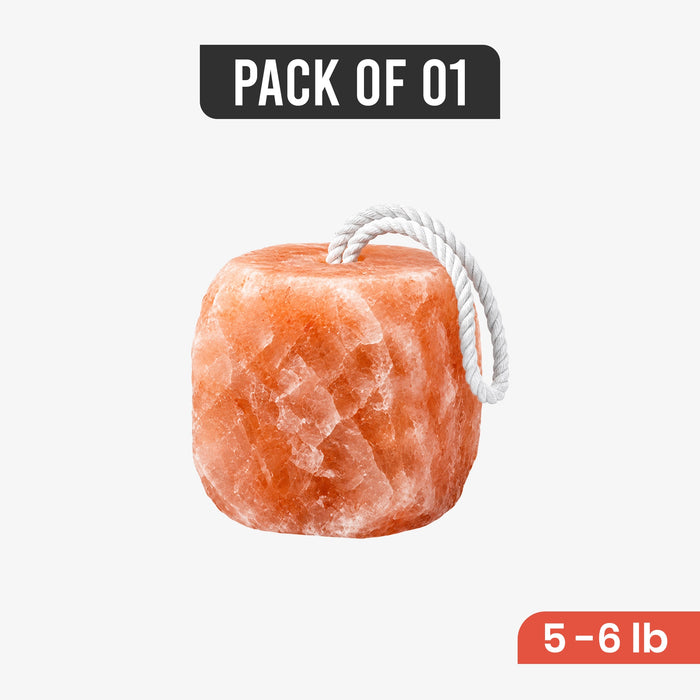
A Himalayan salt lick is a solid block of natural pink rock salt that animals lick when they need salt. NutriSalt blocks are cut from the Khewra Salt Mine in Pakistan, with a 36-inch rope fitted and nothing added. Hang one in a barn, stall or pasture for horses, cattle, goats, sheep or deer, and pick the block size and pack that fits your farm, ranch or stable.

Pick the block weight and shape that suit your animals, then choose your pack for your farm, stable or ranch. Every Himalayan salt lick comes with a rope fitted, and larger packs bring the price per block down.
Shop by animal
Every species uses salt a little differently. Pick your animal to see the right salt lick block size, how much salt it needs and how to hang it.
Why Himalayan salt
Most feed stores sell white or brown pressed blocks made from salt crystals squeezed together. A Himalayan salt lick is cut from one piece of solid rock salt. Here's how they compare.
| Item | NutriSalt Himalayan salt lick | Typical pressed salt block |
|---|---|---|
| How it's made | Cut from natural rock salt | Salt crystals pressed into a block, sometimes with binders |
| Hardness | Very dense, wears down slowly | Softer, easier to bite and crumble |
| In wet weather | Holds up better, still lasts longest under cover | Can soften and break apart faster |
| Added ingredients | None, no molasses, dye, iodine or filler | Varies; some add iodine, trace minerals or molasses |
| Hanging | Rope already fitted | Usually needs a holder or tray |
| Mess | Little, since the block stays hung up | Can leave salty mud around the block |
Rope fitted, nothing added · Ships the same day by 2 PM ET

Salt basics
A salt lick is a block of salt, or a natural salt deposit, that animals lick to get sodium. Grass, hay and grain are low in sodium, so horses, cattle, goats, sheep and deer need extra salt. A Himalayan salt lick is a solid piece of natural rock salt, hung where animals can reach it.
In the wild, you'll see animals licking salt at natural deposits, often called mineral licks. On a farm, an animal salt lick brings the salt to them, free choice, so each animal takes what it needs. University of Maryland Extension calls salt the minimum mineral every sheep and goat should have free choice. Horses and cattle need it every day too.
Honest answer
Himalayan salt is mostly sodium chloride, with small natural traces of potassium, calcium, magnesium and iron that give it its pink color. Those traces are small, so our salt lick isn't a mineral salt block, and we don't sell it as one. Animals still take to it: in a Cornell University study reported by Kentucky Equine Research, horses readily licked Himalayan, plain and mineral blocks alike.
A mineral block or loose mineral is made with set levels of copper, zinc, selenium and phosphorus, usually for one species. Equine nutritionist Dr. Clair Thunes notes that plain salt blocks, trace mineral salt blocks and rock salt blocks are all more than 92% sodium chloride, so she balances trace minerals through the feed instead. Most owners do the same: a plain salt lick free choice, plus a mineral matched to their animals, soil and hay.
Mixed herds need extra care. Oregon State University Extension advises feeding goats and sheep their own minerals, because goats need more copper than sheep can safely eat. A plain salt lick like ours, with no added copper, is safe for both to share.
How to use
Every NutriSalt block comes with a rope fitted, so you don't need a holder. Hang it once and check it every week or two.
Animals drink more after taking salt. Keep clean water close, but not right under the block.
Rain slowly dissolves salt. In a barn, stall, run-in shed or under trees, it lasts much longer.
Tie it snug to a stall ring, post, rail or branch so the block can't swing hard or tangle a leg.
Bossy animals guard the salt. Two blocks in different spots let every animal get its share.
Replace the block when it gets thin or cracked, or when the rope wears.
About NutriSalt
Every NutriSalt block starts at the Khewra Salt Mine in Pakistan's Salt Range, the best-known source of Himalayan salt and one of the oldest salt mines in the world. We've bought our salt directly from the mine since 2015.
Each block is cut, drilled, fitted with a rope and checked by hand for cracks. It then ships to our warehouse in Middle River, Maryland, where we pack and send your order. We're a small team that answers the phone ourselves, so if you're not sure which salt lick to buy, call us.

“I started NutriSalt to give animal owners pure salt, described honestly, at a fair price.”
Muhammad Idrees Munir · Founder of NutriSalt, Pink Salt Wall and Saltite
Stocking a ranch, boarding stable, hunting lease or feed store? Buying salt licks for livestock in bulk lowers the price per block. We offer packs of 10 up to 500 and quote larger orders for:
5–6 lb block · price per block
Questions
Quick answers about buying, sizes and shipping. For animal-by-animal advice, see our guides above.
Right here. Order NutriSalt Himalayan salt licks online in packs of 1 to 500 (5–6 lb block) or 1 to 6 (8–9 lb). Orders placed by 2 PM ET on business days ship the same day from our Maryland warehouse. For bigger orders, request a bulk quote or call (800) 759-7253.
Pick the 5–6 lb block for goats, sheep, deer, ponies and trailers, and the 8–9 lb for horses in a stall and for cattle on fence posts and pastures. When several animals share, hang more than one block so every animal gets a turn.
No. It's natural rock salt, mostly sodium chloride, with tiny natural traces of iron, potassium, calcium and magnesium. Those traces are too small to replace a trace mineral salt block or mineral supplement, so most animals also need a mineral made for their species.
It depends on how many animals use it, the weather and where it hangs. As a rough guide, an 8–9 lb block used by one horse in a dry stall lasts about four months. A block shared by a group or left out in the rain goes much faster.
Not with ours. Every NutriSalt block has a rope fitted, so you tie it straight to a stall ring, post, rail or branch. Hanging keeps the block clean, dry and off the ground.
Orders placed by 2 PM ET on a business day usually ship the same day from Middle River, Maryland, and arrive in 3 to 5 business days. We ship to the contiguous United States, but not to Alaska, Hawaii or Puerto Rico.


